Disinformation and the democratic rule of law
constitutionality in relation to freedom of expression
Keywords:
disinformation, freedom of expression, Democratic Rule of Law, digital democracy, Federal ConstitutionAbstract
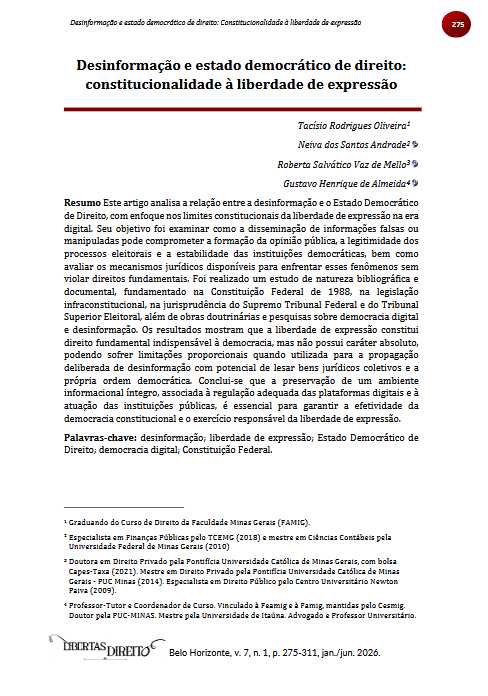
This article analyzes the relationship between disinformation and the Democratic Rule of Law, focusing on the constitutional limits of freedom of expression in the digital age. Its objective was to examine how the dissemination of false or manipulated information can affect public opinion formation, the legitimacy of electoral processes, and the stability of democratic institutions, as well as to assess the legal mechanisms available to address this phenomenon without violating fundamental rights. A bibliographic and documentary study was conducted based on the 1988 Brazilian Federal Constitution, statutory legislation, case law from the Supreme Federal Court and the Superior Electoral Court, as well as doctrinal works and studies on digital democracy and disinformation. The results show that freedom of expression is a fundamental right essential to democracy; however, it is not absolute and may be subject to proportional restrictions when used to deliberately spread disinformation capable of harming collective legal interests and the democratic order itself. It is concluded that preserving an information environment based on integrity, combined with appropriate regulation of digital platforms and effective institutional action, is essential to ensuring the effectiveness of constitutional democracy and the responsible exercise of freedom of expression.